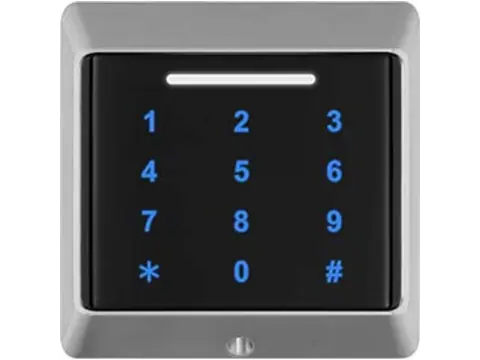
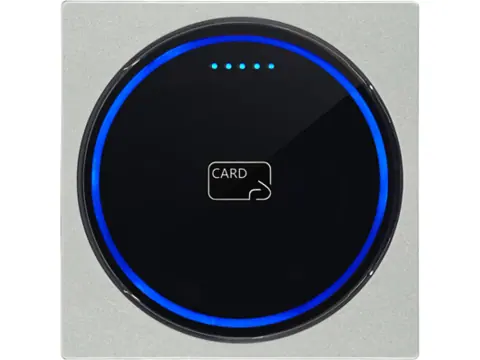
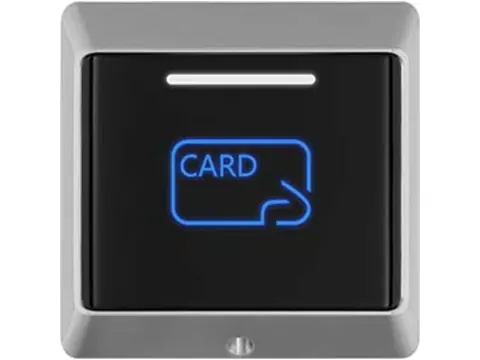
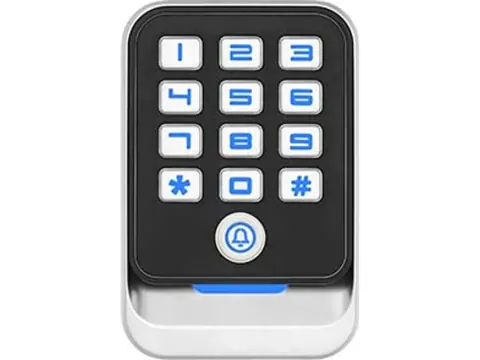
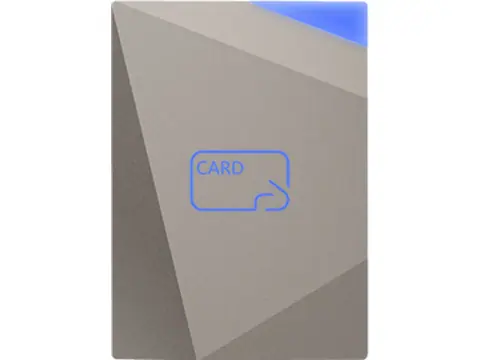
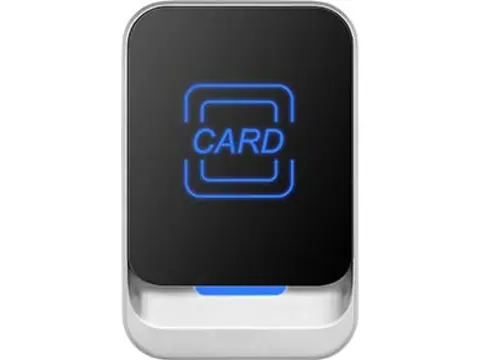
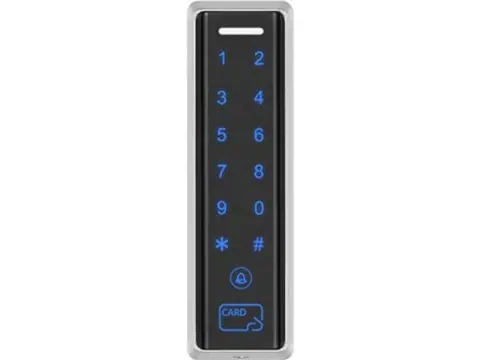
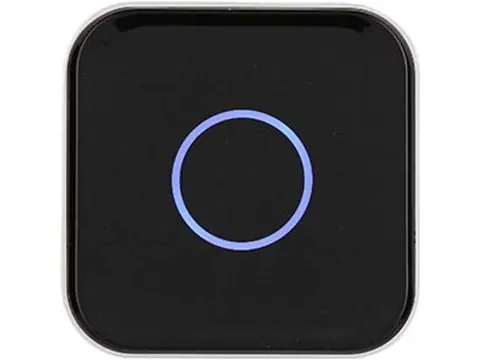
An elevator card reader lets a lift carry each passenger only to the floors their card, fob or QR code allows. The reader sits in the car operating panel or at a lift lobby, sends the credential number to an elevator access controller, and that controller enables the matching floor buttons for a few seconds. We supply the reader side of that chain (card readers, QR readers, OEM reader modules and encrypted cards) and confirm the output format against your floor controller before dispatch.
The problem in residential and office lifts
A lift is the main shared route to every floor, so it carries much of a building’s access-control load. The same few problems come up again and again.
Copied cards. Many older lift readers check nothing but the card’s serial number (UID). A 125 kHz EM4100 fob can be duplicated onto a writable T5577 blank, and a MIFARE Classic UID can be written to a “magic” card with a changeable block 0. Once copies circulate in an apartment block, management loses track of who can reach which floor. The fix is a reader that authenticates the card with a site key, plus a fresh card issue. Our MIFARE Classic vs DESFire guide explains why AES-128 DESFire EV2/EV3 is the stronger long-term choice.
Tight, metal panels. Car operating panels are usually stainless steel with little depth behind the face. Neither a 125 kHz nor a 13.56 MHz field passes through a steel plate, so the reader mounts on the surface or its antenna sits behind a plastic or glass window.
Wiring through the traveling cable. A reader in the car gets power and data through the traveling cable that hangs from the car to a junction box in the hoistway, next to door-operator and lighting circuits. Spare conductors may be scarce, runs in tall buildings are long, and electrical noise is common.
Life safety. Floor restriction must never interfere with fire-service recall or other emergency operation. Lift safety codes, such as ASME A17.1/CSA B44 in North America and the EN 81 series in Europe, apply to any work on the lift controller, and in most jurisdictions only the lift company or a licensed elevator contractor may make that connection.
How an elevator access control system is laid out
- Credential. A resident card or fob (125 kHz or 13.56 MHz), an encrypted card, or a QR code on a phone or printout.
- Reader. In the car operating panel it restricts floor selection per user. At a landing call station, such as a car-park level, it controls who can call the lift at all.
- Elevator access controller. Often called a floor controller, it stores users, floor permissions and schedules. On a valid read it closes relay contacts for the permitted floors for a timed window, typically one relay per restricted floor, or passes the permitted floors to the lift controller over an interface the lift company provides.
- Lift controller. The passenger presses an enabled button. Some systems register the call automatically when a card has only one permitted floor.
Destination-dispatch lifts work differently: passengers choose a floor at a lobby terminal before boarding, and card integration normally runs through the lift company’s own interface. Confirm the reader output it accepts before you order.
The floor controller usually comes from your access-control platform or the lift contractor. Our part is to make sure the reader, cards and output format match it.
Hardware selection by location
| Location |
Recommended hardware type |
Key spec to check |
| Car operating panel, retrofit |
Slim mullion or 86-box card reader, surface-mounted |
Wiegand 26/34 or RS485 output accepted by the floor controller; current draw at 12 V DC over the traveling cable |
| Car operating panel, new build (panel OEM) |
13.56 MHz reader module behind a non-metallic window |
Read distance through the window material; UART/TTL or Wiegand output; supply voltage |
| Apartment lift with copied cards |
Encrypted anti-clone reader plus a matched set of encrypted cards |
Who holds the keys and how future card batches are issued |
| Lobby or car-park landing call station |
Card reader or keypad reader; QR-and-card reader where visitors arrive |
IP rating for damp or semi-outdoor landings; QR scan distance |
| Visitor and contractor access |
QR-and-card reader fed by a visitor platform, or time-limited encrypted cards |
How codes map to floors; Wiegand passes only 24 or 32 data bits |
| Mixed legacy fobs and new cards |
Dual-frequency 125 kHz + 13.56 MHz reader |
Both technologies output in the one format the controller has enrolled |
For car panels and lobbies, start with our Wiegand card and keypad readers, which include mullion and 86 mm square housings. Where copying is the complaint, the encrypted anti-clone readers accept only cards issued under their own key. For visitor floors, the QR code and RFID readers read phone-screen and printed codes alongside 13.56 MHz cards.
Lift-panel manufacturers building the reader into the car operating panel usually prefer a board-level part. Our 13.56 MHz NFC reader modules come with on-board or external antennas, so the antenna can sit behind a window while the board mounts elsewhere in the panel. Request samples and test read distance in your own panel before fixing the design.
What sets the price of a lift card reader
Credential technology matters most: UID-only 125 kHz or 13.56 MHz readers cost least, while encrypted-card and QR-and-card readers cost more. Housing material, ingress rating and output options add to that, and volume changes the unit price. Remember the recurring cost of cards and fobs, which grows with resident turnover.
Integration and installation notes
- Match the output first. Wiegand 26 carries an 8-bit facility code and a 16-bit card number between two parity bits; Wiegand 34 carries 32 data bits. Confirm which format the floor controller expects and how it displays enrolled card numbers, or cards will read but not match.
- Plan the cable run. Wiegand is usually limited to about 150 m (500 ft) on shielded 22 AWG cable, with the shield drain grounded at one end. RS485 reaches about 1,200 m (4,000 ft) on a twisted pair and tolerates noise better. The Wiegand vs OSDP guide compares both.
- Check voltage at the reader. Long conductors in the traveling cable drop voltage, so measure at the reader end during commissioning.
- Keep antennas clear of metal. Test read range in the actual panel before approving the layout, because a steel face or backplate shortens it.
- Separate neighboring readers. Where two cars share a lobby wall, space the readers so their fields do not overlap.
- Coordinate emergency modes. Agree with the lift contractor how restriction is bypassed in fire-service and inspection modes, then test it.
- Commission floor by floor. Test every floor with every card type, plus a visitor QR code if you use them.
Typical bill of materials
- Car reader: one per car, as a surface mullion or 86-box reader, or a reader module for OEM panels
- Landing readers where calls are restricted, such as car-park levels
- QR-and-card reader where visitors or couriers use temporary codes
- Credentials: 125 kHz or 13.56 MHz cards and fobs matching the reader, or an encrypted card set, with spares for new residents
- USB desktop reader for enrolling card numbers at the management office
- 12 V DC power supply for readers not powered from the floor controller
- Floor controller: sourced from your access platform or the lift contractor
- Shielded cable or spare traveling-cable pairs: arranged with the lift contractor
Why source readers and cards from one supplier
Readers and cards have to agree on frequency, card type, key and output format. Buying them together means the key set and number format stay the same for every future batch of cards and key fobs.
We send samples so you can test fit and read range in a real car panel. We also check the output setting against your floor controller before dispatch, and we can ship readers, modules, cards, enrollment readers and power supplies as one mixed order.
Next steps
Tell us the number of cars and floors, whether the panels are retrofit or new build, the card technology already in use, the floor controller and its input (Wiegand 26/34 or RS485), and whether visitors need QR access. Request a quote and we will reply within 24 hours with matched reader, card and sample options.