Key takeaways
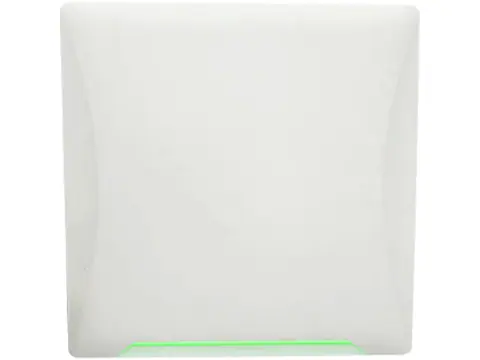
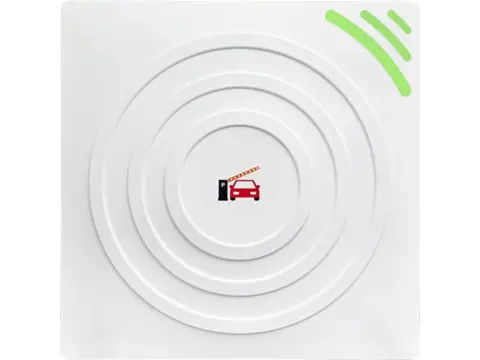
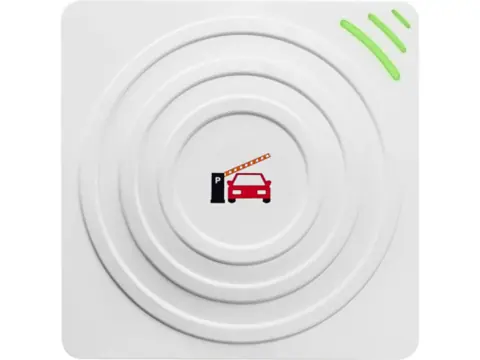
- An integrated reader puts the reader electronics and one antenna in a single housing, which suits one read zone such as a parking lane, gate or single doorway.
- A fixed reader drives external antennas from RF ports, commonly 1–8 per reader, which suits dock doors, conveyor tunnels, cabinets and any zone one antenna cannot cover.
- Most multi-port readers switch between antenna ports in turn, so each added antenna widens coverage but shares the reader's read time.
- Coax runs, antenna mounting and commissioning are the cost lines that grow with antenna count; keep the reader close to its antennas.
- Where several readers share a building, use Gen2 dense reader mode, the lowest power that works and presence triggers to prevent cross-reads.
Choose an integrated UHF reader when you need one read zone, such as a parking lane, a gate or a single doorway, and want one box that mounts, aims and wires like a card reader. Choose a fixed reader with external antennas when one antenna cannot cover the zone, or when one set of reader electronics should serve several nearby zones: dock doors, conveyor tunnels, smart cabinets and portals. The sections below compare definitions, cost, coverage and antenna planning so you can decide zone by zone.
Definitions: integrated, fixed and module-based readers
Integrated reader (all-in-one). The reader electronics and one antenna, usually a circularly polarized patch of about 6–12 dBi, share one sealed housing, and the usual connections are just power and a data cable. Readers built for vehicle and gate access typically output Wiegand 26/34 and RS485 or RS232, and some add TCP/IP or a relay. Because the antenna is covered by the reader’s own authorization, there is no separate antenna approval to check in FCC regions.
Fixed reader (non-integrated, multi-port). A reader with RF ports, commonly 1, 2, 4 or 8, and external antennas connected by 50 Ω coax. Larger counts are possible with high-port-count models or antenna multiplexers. Fixed readers usually connect over Ethernet (TCP/IP) and often provide GPIO for photo-eyes, motion sensors and stack lights. Many support LLRP, the GS1 standard reader interface, while others use a vendor protocol with an SDK.
Hybrids and modules. Some integrated readers include one port for an extra external antenna. At the other end, ceiling-mounted array readers contain many antenna elements in one housing and cover a large area. OEM equipment builders often embed a reader module instead of buying either type.
| Factor | Integrated reader | Fixed reader + external antennas |
|---|---|---|
| Antennas | 1 built-in, typically 6–12 dBi circular | 1–8 ports typical, 16+ with multiplexers; antenna chosen per zone |
| RF output | Set within regional limits (4 W EIRP FCC, 2 W ERP ETSI) | Typically adjustable up to about 30 dBm (1 W) per port, within the same limits |
| Read zones | One, set by where the housing points | One per antenna, shaped by antenna choice and placement |
| Typical range, good tag | About 1–15 m; some vehicle-lane models specified further with large tags | Up to about 10–15 m per far-field antenna; a few cm with near-field antennas |
| Cabling | Power + data | Power + data, plus one coax run per antenna |
| Typical host interface | Wiegand 26/34, RS485, RS232, relay; TCP/IP on some | Ethernet (TCP/IP, often LLRP), RS232, USB, GPIO |
| Enclosure | Often sealed for outdoor mounting (check IP rating) | Reader often indoor or enclosed; antennas available in sealed outdoor housings |
| Direction sensing | Needs a second reader or external sensors | Two or more antennas plus host logic |
Total install cost: reader, antennas, cables and labor
We can’t quote prices in a guide, but the cost lines are predictable, and they scale differently for each architecture.
Integrated reader, per read zone:
- One reader and a mounting bracket or pole
- One power and data cable to the controller or network
- Labor to mount, aim, wire and set region, power and output format
Fixed reader, per installation:
- One reader, plus a power supply or PoE switch port where the model supports it
- N antennas and brackets
- N coax runs with connectors, and weatherproofing for any outdoor connector
- An enclosure if the reader is not in a clean indoor space
- Host software or middleware to filter reads, apply direction logic and pass events on
- Commissioning time: per-antenna power tuning, dense reader settings and testing with real loads
For a single zone, the integrated reader is almost always simpler: fewer parts, one cable and no RF cabling to get wrong. As zones multiply within a short cable run of one reader position, the fixed reader pulls ahead, because an extra antenna and cable usually cost less than another complete reader.
Distance is the limit on that saving. At about 900 MHz, thin RG-58-class coax loses roughly 0.5–0.7 dB per meter, so a 10 m run can throw away more than two-thirds of the power. The same run in 10 mm-class (0.4 in) low-loss cable loses about 1.3 dB. When zones are far apart, run Ethernet to a second reader instead of running long coax.
Coverage: single zone vs multi-antenna zones
An integrated reader projects one beam from wherever you mount it. A 9 dBi panel has a 3 dB beamwidth of roughly 60–70°, and higher-gain panels are narrower. That shape suits a lane, where every vehicle passes the same point with its windshield tag facing the reader. It does not suit a pallet, where tags face every direction and the load itself blocks the far side.
A fixed reader lets you build the zone from several antennas. You can place them on both sides of a doorway, overhead or under a conveyor, mix far-field panels with near-field antennas, and set power per port so each antenna covers only its own area. Reads are reported per antenna, which tells your software which door, shelf or side of a portal saw the tag, and the order of reads can indicate direction.
The trade-off is time. Most multi-port readers have one transceiver that switches between ports in sequence, so four antennas each get only part of the read cycle. For slow or stationary tags this rarely matters. For fast conveyors or forklifts moving through a portal, test at real speed before adding more antennas to one reader.
When integrated readers win: gates, lanes and single doors
- Parking lanes and vehicle gates. One reader per lane, aimed at the windshield tag path, with Wiegand output to the barrier or access controller. The long-range integrated UHF readers are built for this, and our vehicle access control page covers tags, lane layout and barrier logic.
- Single doorways and personnel lanes. Where hands-free UHF badges are acceptable, one reader covers the approach. Human bodies absorb UHF, so badge position matters; test with the way people actually wear badges.
- Projects run by access-control installers. An integrated reader wires like a card reader. There is no coax to terminate and no antenna to match.
- Pilots and proofs of concept. One box gives a quick, repeatable test of tags and read distance before you design a multi-antenna system.
When fixed readers and antennas win: dock doors, tunnels and cabinets
- Dock doors and portals. Pallets carry tags on several faces, and product shields tags from one side. Antennas on both sides of the door, and often at two heights, fill the doorway. See UHF RFID for warehouses and dock doors.
- Conveyor tunnels. Antennas above and beside the belt, sometimes below it, inside a metal or absorber-lined tunnel that keeps the field off neighboring lines.
- Smart cabinets, shelves and tool cribs. One near-field or low-gain antenna per shelf or drawer, at low power, so each read maps to a location.
- Several zones near one point. Two adjacent doors, or a door plus a staging area, can share one reader when the coax runs stay short.
- Harsh or public sites. The reader stays in an equipment room or enclosure, and only UHF antennas are exposed.
- Software-led systems. Per-antenna events, GPIO triggers and LLRP suit warehouse and ERP integrations better than a Wiegand number.
Fixed multi-port UHF readers are available in several port counts. Choose one with a spare port or two, so a door that needs a third antenna after testing doesn’t need a new reader.
Antenna count planning for portals and dense reader mode
Plan antennas from the read zone, not from the reader’s port count:
- Measure the zone. Width, height and the distance from each antenna position to the farthest tag, in meters.
- List the tag positions. Which faces of the item carry tags, and what is behind them: metal, liquid or people.
- Note speed and quantity. How fast items move through the zone and how many tags pass at once.
- Start from a typical count, then adjust after a site test with real tags and loads.
| Read point | Typical zone size | Starting antenna count | Usual antenna type |
|---|---|---|---|
| Vehicle lane | One lane, about 3–3.7 m (10–12 ft) wide | 1 integrated reader per lane | Built-in, about 9–12 dBi |
| Personnel doorway | About 0.9–1.2 m (3–4 ft) wide | 1–2 | 6–9 dBi circular |
| Dock door | About 2.5–3 m (8–10 ft) wide and high | 2–4 | About 9 dBi circular |
| Conveyor tunnel | Belt about 0.3–1 m wide | 2–4, more for tags on any face | 6–9 dBi, or near-field for small items |
| Cabinet or shelf | About 0.3–0.6 m deep per shelf | 1 per shelf or drawer | Near-field or low-gain |
For polarization and gain choices, see circular vs linear polarized antennas.
Dense reader mode. Adjacent dock doors put several readers within range of each other, and a reader’s strong carrier can drown out the weak tag replies another reader is trying to hear. EPC Gen2 dense reader mode addresses this: readers transmit with a narrow spectrum, and tags reply on a Miller-encoded subcarrier that sits away from other readers’ carriers. Dense reader profiles read somewhat slower than the fastest modes, but they hold up when many readers share a site.
Regional rules affect how crowded the spectrum is. Under FCC rules, readers typically frequency-hop across 50 channels of 500 kHz in 902–928 MHz. Under ETSI EN 302 208, high-power operation in 865–868 MHz uses only four channels (865.7, 866.3, 866.9 and 867.5 MHz), so dense European sites rely more on reader settings and scheduling. Check your band in UHF RFID frequency by country.
To prevent cross-reads between neighboring zones:
- Enable dense reader mode on every reader in the area.
- Use the lowest power that reads reliably, set per antenna.
- Aim antennas into their own zone and away from neighboring doors.
- Add metal or RF-absorbing panels between adjacent portals where needed.
- Trigger reading with photo-eyes or motion sensors, so readers transmit only when a load is present.
- Use the readers’ synchronization or scheduling features where they support them.
Recommendation matrix
| Project | Recommended setup | Antennas | Common interface | Watch for |
|---|---|---|---|---|
| Parking lane or barrier gate | Integrated reader | 1 built-in per lane | Wiegand 26/34 to controller | Metallized windshields; cross-lane reads |
| Entry and exit lanes side by side | Two integrated readers | 1 per lane | Wiegand or RS485 | Aim each reader away from the other lane |
| Hands-free personnel door | Integrated, or 2-port fixed | 1–2 | Wiegand or TCP/IP | Body shadowing; badge position |
| Warehouse dock door | Fixed reader, 4 ports | 2–4 | TCP/IP or LLRP, GPIO | Dense reader mode; presence trigger |
| Conveyor tunnel | Fixed reader | 2–4 in shielded tunnel | TCP/IP, GPIO | Tag speed versus port switching |
| Smart cabinet or shelf | Fixed reader or multi-port module | 1 per shelf | USB, RS232 or TCP/IP | Low power; near-field antennas |
| Single-zone pilot | Integrated reader | 1 built-in | RS232, USB or TCP/IP | Test with production tags |
Site survey checklist
- Number of read zones and the distance between them, in meters
- Zone size and distance from the antenna position to the farthest tag
- Tag type, mounting surface and orientation on each item
- Speed through the zone and number of tags per pass
- Operating country and UHF band: FCC 902–928 MHz, ETSI 865–868 MHz or another plan
- Host system: access controller (Wiegand, RS485) or software (TCP/IP, LLRP, SDK)
- Indoor or outdoor, IP rating and temperature range needed
- Coax route and length for each antenna, with connector types
- Other readers nearby, and whether dense reader mode and triggers are needed
- Power source: 12 V DC supply, PoE or a local mains adapter
Next steps
Send us a sketch of each read zone with dimensions, the tags you plan to use, the operating country and the system the reader must report to. We will recommend an integrated or fixed setup, count the antennas and cables, confirm the correct band version before dispatch, and arrange samples for a site test. Request a quote or samples and we will reply within 24 hours.
Frequently asked questions
What is the difference between an integrated and a fixed RFID reader?
An integrated reader has its antenna built into the reader housing and covers one read zone. A fixed reader has RF ports for external antennas, so one reader can cover several zones, or one large zone, with antennas placed where the tags actually pass.
How many antennas do I need for a dock door?
Two antennas, one on each side of the door, is a common starting point, and four (two per side at different heights) is typical for mixed cartons on pallets. Confirm the count with a site test using your real tags and loads.
Can an integrated UHF reader connect to a standard access controller?
Yes. Most integrated readers made for vehicle and gate access output Wiegand 26 or 34, and many also offer RS485 or RS232, so they wire to an access controller or barrier controller much like a card reader.
Does adding antennas to a fixed reader make it read faster?
No. Most multi-port readers have one transceiver that switches between ports, so more antennas widen coverage but split the read time between them. For fast-moving tags, use fewer antennas per reader or add readers.
What is dense reader mode?
It is an EPC Gen2 operating mode for sites with many readers close together. Readers transmit with a narrow spectrum and tags reply on a Miller-encoded subcarrier offset from the reader carriers, which reduces reader-to-reader interference at some cost in read speed.
Can a fixed reader be installed outdoors?
Many fixed readers are designed for indoor or enclosed mounting, so outdoor sites usually put the reader in a weatherproof enclosure and expose only the antennas. Check the reader's IP rating and operating temperature, and weatherproof every outdoor coax connector.
Want a second opinion on your spec?
Send us your controller, credential type and environment — we'll recommend compatible hardware and quote within 24 hours.