Key takeaways
- Passive UHF read range is set by the whole RF link: radiated power, antenna gain and aim, cable loss, tag sensitivity and the surface behind the tag.
- Regulators cap radiated power at 4 W EIRP (FCC) or 2 W ERP (ETSI), so real gains come from better tags, alignment and lower losses, not from more power.
- In free space, 6 dB of extra link margin roughly doubles read distance; losing 3 dB cuts it to about 70%.
- Metal, liquids, people and metallized windshields are the usual range killers, and the fix is most often a different tag or tag position.
- 125 kHz long-range readers couple through a magnetic near field and rarely read beyond about 1 m; hands-free vehicle lanes need UHF.
Passive UHF RFID read range runs from a few centimeters on a desktop encoder to roughly 10–15 m for a fixed or integrated reader reading a well-matched tag in open space. Where your project lands depends on the whole RF link — regulated transmit power, antenna gain and aim, cable loss, tag sensitivity and the material behind the tag — far more than on the reader’s headline number. This guide explains each factor and the fixes that actually add meters.
Typical read ranges by device type
Read-range figures on datasheets are usually measured with the best-performing tag the vendor has, facing the antenna, in a clear space. Use them to compare devices, not to promise a distance to your customer. Ask for the test tag and conditions behind any range claim.
| Device type | Typical RF setup | Typical range, good label or card tag | Typical use |
|---|---|---|---|
| Desktop USB reader/writer | Low power, small built-in antenna | 0–0.5 m (short by design) | Enrollment, tag encoding |
| Embedded UHF module | Configurable output, commonly up to 30–33 dBm; external or ceramic antenna | Tens of cm at low power; fixed-reader range at full power with a good antenna | OEM devices, kiosks, cabinets |
| Handheld reader | Built-in circular antenna | About 1–8 m; some pistol-grip models specified beyond 10 m | Inventory counts, asset audits |
| Integrated reader | Built-in 9–12 dBi antenna | About 1–15 m; some vehicle-lane models specified to 20–30 m with large tags | Parking, gates, vehicle access |
| Fixed reader + external antennas | Up to 30 dBm per port, 6–9 dBi antennas | Up to about 10–15 m in open space | Dock doors, tunnels, portals |
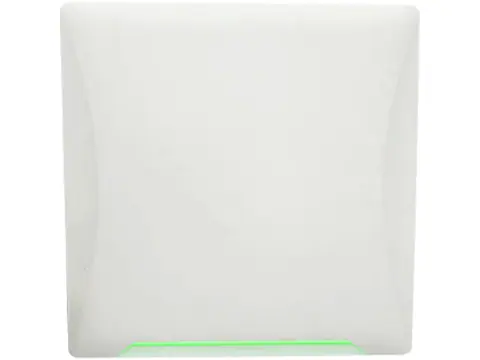
For vehicle lanes and gates, the long-range integrated UHF readers are the usual starting point because the antenna, reader and output are in one weatherproof housing. Fixed readers with external antennas make sense when you need several read points or a precisely shaped zone.
Tag choice moves these numbers more than most buyers expect. A small on-metal tag may read at tens of centimeters on the same reader that reads a 100 mm label at several meters.
The link budget in plain English
A passive UHF tag has no battery. It harvests energy from the reader’s signal to wake its chip, then replies by backscatter — reflecting part of that signal back with its data modulated onto it. Two links therefore have to close:
- Forward link (reader to tag): enough power must reach the tag chip to switch it on. Tag chips in wide use are specified at roughly –18 to –24 dBm read sensitivity, with newer generations at the more sensitive end. A finished tag performs worse once antenna efficiency and mounting losses are counted.
- Reverse link (tag to reader): the reader receiver must hear the weak backscatter above noise and its own transmitter leakage.
In most passive UHF systems, the forward link runs out first. Read range is essentially the distance at which the reader can still deliver the chip’s minimum operating power.
Radiated power and the regulatory ceiling
Radiated power is expressed as EIRP: conducted power minus cable loss plus antenna gain. In the US, FCC Part 15 rules for 902–928 MHz allow 1 W (30 dBm) conducted with an antenna of up to 6 dBi, giving 4 W (36 dBm) EIRP. Above 6 dBi, conducted power must drop by the same amount. In Europe, ETSI EN 302 208 allows 2 W ERP — about 35.1 dBm EIRP — on the high-power channels in 865.6–867.6 MHz.
The two regimes differ by only about 1 dB, so the band itself is rarely why a European installation reads shorter than an American one. What matters more is ordering the correct band version; see UHF RFID frequency by country for regional allocations.
A worked example
The table below is an idealized free-space budget at 915 MHz. It ignores multipath and tag impedance-matching losses, so it shows a ceiling, not a design figure.
| Item | Value | Note |
|---|---|---|
| Reader conducted power | +30 dBm (1 W) | FCC maximum conducted |
| Cable and connector loss | –1 dB | Short run of low-loss coax |
| Reader antenna gain | +6 dBi | Circular polarization |
| EIRP | +35 dBm (about 3.2 W) | Under the 36 dBm FCC cap |
| Free-space path loss at 10 m | –51.7 dB | Rises 6 dB per doubling of distance |
| Polarization mismatch | –3 dB | Circular antenna, linear tag |
| Tag antenna gain | +2 dBi | Close to an ideal dipole; many inlays are lower |
| Power at tag chip, 10 m | about –17.7 dBm | Sum of the lines above |
| Example chip read sensitivity | –20 dBm | Chip-level figure |
| Margin at 10 m | about +2.3 dB | Theoretical limit about 13 m |
Two rules of thumb follow from free-space loss. Every 6 dB of extra margin roughly doubles range, and every 3 dB lost — a longer cable, a mismatched tag, a person in the path — cuts range to about 70%. Real sites need several decibels of fade margin for reflections and orientation, which is why a well-designed installation targets a distance well inside the theoretical figure.
Tag factors: size, chip and mounting surface
The tag is usually the weakest part of the link and the cheapest to change.
- Antenna size. A larger tag antenna captures more energy. Compact tags trade distance for footprint.
- Chip generation. Newer chips need less power to wake up, so the same inlay design with a newer chip can read noticeably farther.
- Mounting surface. Tag antennas are tuned for what sits behind them. A standard label placed directly on steel may not read at all, and liquids detune and absorb. On-metal tags use a spacer or ground-plane design that turns the metal into part of the antenna.
- Band tuning. Broadband 860–960 MHz tags work in any region. Tags tuned narrowly for one band lose range in the other.
- Orientation. A dipole tag reads poorly when its long axis points at the antenna. A tag seen edge-on also loses signal.
- Read vs write. Writing needs more power than reading, so write range is typically shorter than read range. Encode tags close to the antenna.
Environment: metal, water, people and interference
Metal reflects UHF energy. Reflections combine with the direct signal and create multipath: spots where signals add, and nulls where they cancel. A tag that reads well in one position can fail a few centimeters away. Metal shelving, vehicle bodies and roller doors are classic causes of “it worked on the bench” failures. For mounting advice, see does RFID work on metal.
Water and human bodies absorb UHF strongly. A badge worn against the chest reads much shorter than the same badge held up, and a crowd in a portal shadows tags behind it. Cartons of liquid behave the same way.
Interference comes in two forms. Several readers in one area can drown out each other’s tag replies; Gen2 dense reader mode separates reader transmissions from tag responses in frequency, and many readers also support scheduling or synchronization. Electrical noise from variable-frequency drives, LED drivers and switching supplies — or strong transmitters in adjacent bands — raises the receiver noise floor and shortens the reverse link.
Why 125 kHz long-range readers stop near 1 m
At 125 kHz the wavelength is about 2.4 km, so every practical reading distance lies deep in the near field. The reader and tag couple through a magnetic field, like a loosely coupled transformer. Once you move beyond the size of the reader’s loop, that field strength falls roughly with the cube of distance: double the distance and the field drops to about one-eighth, and the power the tag can harvest falls faster still.
“Long-range” LF readers push this with large loops and high drive current, yet they rarely reach beyond about 1 m, and standard ISO cards read shorter. HF 13.56 MHz follows the same physics: ISO/IEC 14443 is designed for around 10 cm, and ISO/IEC 15693 vicinity cards reach roughly 1 m with large antennas.
UHF works differently. At 860–960 MHz the wavelength is only 31–35 cm, and tags operate in the radiated far field, where power falls with the square of distance. That difference is why UHF reaches meters. If drivers must not stop or lower a window, specify UHF; LF long-range suits slow approaches to a reader post.
Practical fixes: antenna angle, polarization and power
Work through these in order. The first items usually recover the most range for the least cost.
- Fix the tag first. Match the tag to the surface and use the largest inlay the item allows.
- Aim the antenna. Point the center of the beam at where the tag will be, at the same height, with the tag face parallel to the antenna face. A small change in tilt can move a vehicle tag from the edge of the beam to its center.
- Match polarization. Circular antennas read tags in any rotation but give up about 3 dB against a linear antenna aligned with the tag. When orientation is fixed, as on a conveyor, a linear antenna recovers that margin. See circular vs linear RFID antennas.
- Cut cable loss. Thin coax can lose more than 0.5 dB per meter at 900 MHz; low-loss 10 mm-class cable loses a fraction of that. Keep runs short and avoid chains of adapters.
- Use antenna gain wisely. A higher-gain UHF antenna narrows the beam and improves receive sensitivity, but it does not raise the legal EIRP ceiling. Pick gain for beam shape: narrow for a long lane, wide for a doorway.
- Set region and power correctly. Configure the reader for its country and never exceed the certified limit. Sometimes the fix is less power, to stop stray reads from an adjacent lane or dock door.
- Tune the protocol. Gen2 session, Q and dense reader settings improve multi-tag reliability, not raw distance. Adjust them after the RF layout is right.
Read-range troubleshooting checklist
- Correct band version for the installation country (902–928 MHz, 865–868 MHz, or other)
- Tag type matches the mounting surface (metal, glass, plastic, liquid-filled)
- Tag tested on the real item, not in free air
- Antenna aimed at the tag path, at tag height, with no metal or glass directly in front
- Polarization matched to how tags are oriented
- Coax length and type known; every connector tight and weatherproofed outdoors
- Reader power and region settings checked against local rules
- Other readers, motors and radio transmitters nearby identified
- RSSI logged at several positions to find nulls before fixing the mounting
Vehicle windshields and metallized glass
Standard laminated windshields pass UHF with modest loss, which is why windshield tags work well on many cars. The exceptions are heat-reflective (solar-control) windshields with thin metallic coatings, heated windshields with embedded wires, and aftermarket tint films that contain metal. These can attenuate UHF so much that a windshield tag will not read at any practical distance.
Many vehicles with coated glass leave an uncoated area for toll and parking transponders, often near the rear-view mirror mount. Check the owner’s manual, or look for a dotted or differently shaded patch in the glass. Place the tag there.
Use tags designed for glass. A windshield tag is tuned for the glass behind it and may read poorly if stuck on plastic or metal. Tamper-evident tags that break when peeled off stop users from moving a credential between vehicles. For vehicles where no uncoated area exists, headlamp tags or on-metal tags near the license plate are common alternatives.
Aim the reader at the windshield path of the approaching vehicle, not at the lane center. Test with real vehicles from the actual fleet, including trucks, whose windshields sit higher. For barrier integration, see the vehicle access control application page.
Next steps
Tell us the installation country, the tag and surface, the distance you need, and the controller or software the reader must talk to. We will confirm the correct band version, suggest a reader, antenna and tag combination, and arrange samples so you can test on site before a volume order. Request a quote or samples and we will reply within 24 hours.
Frequently asked questions
What is the maximum read range of a passive UHF RFID reader?
Within legal power limits, fixed and integrated readers typically read good label or card tags at up to about 10–15 m in open space. Some vehicle-lane readers are specified at 20–30 m with large windshield tags, but treat those as best-case figures and verify them on site.
How do I increase UHF RFID read range without breaking power limits?
Start with the tag: use a larger inlay or a tag designed for the mounting surface. Then aim the antenna at the tag path, match polarization, shorten or upgrade the coax, and remove metal or people from the line of sight.
Does a higher-gain antenna give more read range?
It concentrates energy into a narrower beam and improves receive sensitivity, which can extend range along the beam axis. Under FCC rules conducted power must be reduced dB for dB above 6 dBi, so the legal EIRP ceiling does not rise.
Why won't my UHF windshield tag read on some cars?
Many vehicles use heat-reflective or heated windshields with metallic layers that block UHF. Mount the tag in the uncoated area many such windshields provide, often near the rear-view mirror, or use a headlamp or plate-area tag instead.
Can a 902–928 MHz reader read tags sold for Europe?
Usually yes if the tag is a broadband 860–960 MHz design, which most general-purpose tags are. Tags tuned narrowly for one region lose range in the other band, so specify the destination country when ordering.
Why do 125 kHz long-range readers stop at about 1 m?
LF readers power the tag through magnetic near-field coupling, and that field strength falls with the cube of distance. UHF uses radiative far-field coupling, where power falls with the square of distance, so it reaches meters rather than centimeters.
Want a second opinion on your spec?
Send us your controller, credential type and environment — we'll recommend compatible hardware and quote within 24 hours.