Key takeaways
- Pick the form factor from the job first: tags moving past a fixed point need a fixed or integrated reader; tags spread across a site need a handheld.
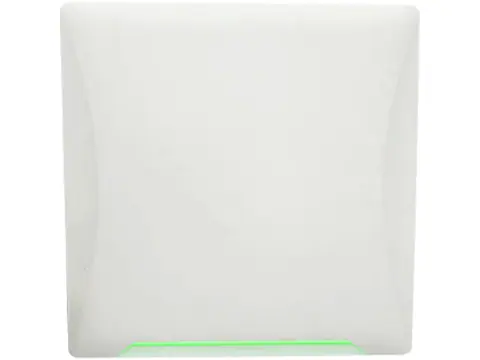
- Integrated readers suit single gates, lanes and doors; fixed multi-port readers suit dock doors, tunnels and cabinets that need several antennas.
- Regional rules cap radiated power (4 W EIRP under FCC rules, 2 W ERP under ETSI EN 302 208), so a higher power spec does not always mean longer legal range.
- For access control, check which part of the tag number the reader packs into Wiegand 26 or 34 bits so card numbers stay unique.
- Ask for range and tags-per-second figures with their test conditions, and order the variant for the destination country's band.
Choose a UHF RFID reader by where the tags are when you need to read them. If tags pass a fixed point, use an integrated reader for a single gate or lane, or a fixed multi-port reader with external antennas for dock doors, tunnels and cabinets; if people walk to the tags, use a handheld; for encoding at a desk, use a USB desktop writer; and to build RFID into your own device, use a module. Then check RF power, interfaces, environment rating and regional band before you request a quote.
Decision tree by use case
Three questions settle most projects. Does the tag move past the reader, or does the reader move to the tag? How many read points does one location need? And what consumes the data: a door controller, a PLC or an IT system?
- The reader moves and the tags stay put? Handheld.
- Tags pass through one narrow lane or doorway? Integrated reader.
- A wide opening, a tunnel, or a zone one antenna can’t cover? Fixed reader with external antennas.
- Tags come to a desk one at a time? Desktop writer.
- The reader goes inside a product you build? Module.
| If you need to… | Start with | Why |
|---|---|---|
| Identify vehicles or people at one gate, barrier or door | Integrated long-range reader | Antenna, reader and Wiegand or relay output in one weatherproof housing, with one cable run to the controller |
| Cover a dock door, portal, conveyor tunnel or smart cabinet | Fixed multi-port reader plus 2–8 antennas | Several antennas shape one read zone; network interface and GPIO for sensors and lights |
| Count stock, audit assets or find a missing item | Handheld reader | No installation; many models add a signal-strength locate mode and barcode scanning |
| Encode tags, issue UHF cards or enroll vehicle tags | Desktop USB writer | Short, controlled range, so only the tag on the pad is written |
| Add UHF to your own kiosk, locker, printer or handheld | Reader module | Board-level engine with UART or USB; you supply antenna, power and enclosure |
Form factor comparison: range, ports, interfaces, cost
| Form factor | Antenna | Indicative read range* | Antenna ports | Common interfaces | Typical power | Relative cost per read point |
|---|---|---|---|---|---|---|
| Integrated | Built in, commonly 6–12 dBi | About 1–15 m; long-range lane models more | None (built in) | Wiegand 26/34, RS485, RS232, relay; TCP/IP on some | 12 V DC | Low to medium |
| Fixed multi-port | External, chosen per site | Up to about 10–15 m per antenna | 1, 2, 4, 8 or 16 | TCP/IP, RS232, RS485, GPIO; LLRP on some | DC adapter; PoE on some | Medium to high, plus antennas, cables and mounts |
| Handheld | Built in, usually circular | About 1–8 m; some models beyond 10 m | None | Wi-Fi, Bluetooth, 4G, USB; Android SDK | Rechargeable battery | Medium to high per unit; no installation |
| Desktop | Built in, low gain | Under 0.5 m by design | None | USB (HID keyboard emulation or virtual COM) | USB 5 V | Low |
| Module | External, your choice | Depends on antenna and power setting | 1–8 | TTL UART, USB | DC from the host board | Low per unit; engineering time is the main cost |
*Indicative open-space figures with suitable EPC Gen2 tags. Tag size, mounting surface, regional power limits and the site all change the real result.
Integrated or fixed? An integrated reader is quicker to install and cheaper per lane, but you can shape its read zone only by aiming it and setting power. A fixed reader costs more per door once antennas and cables are added, yet it covers wide openings, tunnels and cabinets by switching between several antennas in turn.
Desktop writers stay deliberately short-range. Many type the tag number into any software as a USB keyboard, which makes enrolling vehicle tags or UHF cards into a parking or access system simple.
Modules cut unit cost but move work to your engineers: 50 Ω antenna matching and cabling, a supply that handles transmit current peaks, heat removal at high duty cycles, and radio certification of the finished product unless the module’s own approval covers your configuration.
Handheld vs fixed: when mobile counts win
A handheld goes to the tags; a fixed reader waits for the tags to come to it. That difference decides most projects.
A handheld wins when:
- Tags are spread across a store, yard or warehouse with no single chokepoint.
- A periodic count is enough and you don’t need every movement.
- Staff must find specific items; a signal-strength locate mode guides them to the tag.
- Cabling, mounts and power at every door are impractical or not allowed.
- One device must serve several sites.
A fixed reader wins when:
- You need a time-stamped event every time an item passes a dock door, gate or conveyor.
- Reading must happen unattended, around the clock.
- Throughput is high: pallets on forklifts, cases on conveyors, vehicles in a lane.
- You need direction of travel, which a fixed reader can infer from two antennas or from sensors wired to its GPIO.
Many sites use both: fixed readers at chokepoints, handhelds for exceptions and cycle counts. For bulk counts, ask how the handheld uses EPC Gen2 sessions. A session whose inventoried flag persists (S2 or S3) keeps already-counted tags quiet while the operator walks on, which speeds up large counts.
Specs that matter: RF power, sensitivity, tags per second
RF output power. Readers quote conducted power in dBm, where 30 dBm is 1 W. Most let you adjust it in software, and you will often turn it down to shrink a read zone or stop stray reads. Some modules can deliver 33 dBm (2 W), which is more than FCC rules allow at the antenna port, so power must always be set for the region and antenna. What the rules actually cap is radiated power:
- FCC, 902–928 MHz: up to 1 W (30 dBm) conducted into an antenna of up to 6 dBi, which gives 4 W EIRP (36 dBm). Above 6 dBi, conducted power must drop 1 dB for every extra dB of antenna gain.
- ETSI EN 302 208, 865–868 MHz: up to 2 W ERP, about 3.3 W EIRP (35.15 dBm), on four high-power channels.
For example, a reader set to 30 dBm feeding a 9 dBi antenna through a cable with 1 dB of loss radiates about 38 dBm EIRP. That exceeds both limits, so the installer turns power down. A higher power spec does not guarantee longer legal range.
Receive sensitivity. Quoted as a negative dBm figure; more negative is better (−85 dBm beats −75 dBm). In open space, the tag’s need for enough power to wake up usually limits range before the reader’s hearing does. Sensitivity matters more with long antenna cables, many readers nearby, electrically noisy sites and small tags with weak replies.
Tags per second. Headline inventory rates are best-case figures. Real throughput depends on the Gen2 link settings (tag data rate and FM0 or Miller encoding), the number of tags in the field, the session setting and the site. Faster settings read more tags in clean conditions; Miller modes (M = 2, 4 or 8) trade speed for better noise immunity near other readers. Ask for the test conditions behind any rate, then test with your own tag population.
Dense reader mode. When several readers or antennas work close together, as at adjacent dock doors or parking lanes, dense reader mode keeps tag replies spectrally apart from neighboring reader transmissions. Confirm support if you plan more than one read point in the same area.
Also check: the antenna connector type (SMA, TNC, RP-TNC or N), antenna detection on each port, GPIO count, power draw at full output and heat at continuous duty.
Interfaces for access control and IT systems
Access control. Most access controllers and barrier boards accept Wiegand 26 or Wiegand 34. Wiegand 26 carries 24 data bits (typically an 8-bit facility code and a 16-bit card number) plus 2 parity bits; Wiegand 34 carries 32 data bits plus 2 parity bits. A UHF tag’s EPC is commonly 96 bits, so the reader sends only a slice, often the last 3 or 4 bytes, and some readers can send part of the TID instead. Encode tags so that slice is unique across the site, match the format in the controller, and run a common ground between reader and controller.
All-in-one readers with a built-in relay can open a barrier without a separate controller, and RS485 suits parking and access platforms that support the reader’s protocol. On security: EPC memory can be copied to another tag. Reading the TID, which the chip keeps in locked memory, or password-locking tag memory raises the bar against casual cloning, but it is not cryptographic protection.
IT and industrial systems.
- TCP/IP (Ethernet) with an SDK or API; PoE (IEEE 802.3af or 802.3at) removes a separate power run where the reader supports it.
- LLRP, the GS1 Low Level Reader Protocol, lets compatible middleware talk to readers from different makers. Only some readers support it, so confirm per model.
- RS232 or RS485 for PLCs and embedded controllers; USB as HID keyboard emulation or a virtual COM port.
- GPIO inputs for photo-eyes or motion sensors that trigger reading, and outputs for stack lights or buzzers.
- Handhelds add Wi-Fi, Bluetooth and 4G, plus an Android SDK. For 4G, confirm LTE band compatibility with your country before ordering.
Environment: IP rating, temperature, metal and liquids
IP rating (IEC 60529). The first digit covers dust, the second water. IP65 is dust-tight and resists water jets, IP66 resists powerful jets, and IP67 survives temporary immersion up to 1 m for 30 minutes. Outdoor lane readers should be at least IP65, and connectors and cable glands need the same protection as the housing.
Temperature. Compare the operating range (°C) with the worst case on site, including direct sun on a dark housing or a sealed enclosure. Readers at full power and continuous duty run hot, so ask whether output drops when the reader reaches its thermal limit.
Metal and liquids. Metal reflects UHF, creating dead spots and stray reads; water and people absorb it. On metal assets, use on-metal tags and test the read zone with real objects in place; our on-metal tag guide covers the options. For tags in random orientation, a circular-polarized antenna is the safer choice. For tags with a fixed, known orientation, an aligned linear antenna gives up to about 3 dB more margin. To stop stray reads from a neighboring lane, lower power, re-aim the antenna or filter by RSSI. Metallized, heat-reflective windshields can block UHF, so check for an uncoated zone or use a headlamp tag.
Region band and compliance
| Region | UHF RFID band | Radiated power limit | Notes |
|---|---|---|---|
| United States, Canada | 902–928 MHz | 4 W EIRP (36 dBm) | Frequency hopping; FCC Part 15 in the US |
| EU and other ETSI markets | 865–868 MHz (high-power channels 865.6–867.6 MHz) | 2 W ERP (about 3.3 W EIRP) on four channels | EN 302 208; some countries also open an upper band near 916–919 MHz |
| Japan, China, Australia and many other Asia-Pacific markets | Narrower bands between about 916 and 926 MHz | Per national rules | Some require a license or registration; check each country |
Reader and tags must suit the band where they will run. Many readers ship as region-specific variants, such as a US 902–928 MHz version and an EU 865–868 MHz version. So-called global hardware still has to be set to the destination’s region profile and approved there. The full country list is in our guide to UHF RFID frequency by country.
For compliance, a radio device sold in the US needs FCC equipment authorization. In the EU it needs CE marking under the Radio Equipment Directive (2014/53/EU), usually shown against EN 302 208, and other countries run their own type approval. Ask for the test reports that match the exact variant you are buying, and don’t assume an approval in one region carries over to another. On the tag side, many inlays cover 860–960 MHz with uneven performance across the band, and on-metal tags are often tuned for one region.
RFQ checklist
Send these details with your inquiry for a like-for-like quote:
- Application and read point: gate or lane, dock door, tunnel, cabinet, handheld count, desk encoding or OEM product
- Destination country, which sets the band: FCC 902–928 MHz, ETSI 865–868 MHz or other
- Tags or credentials: windshield tag, UHF card, on-metal tag or label; quantity; pre-encoding or printing
- Read requirement: distance (m), tags at once, speed of movement, tag orientation
- Host interface: Wiegand 26 or 34 (and which bytes), RS485 or RS232 protocol, TCP/IP with SDK or LLRP, USB keyboard emulation, relay
- Antennas for fixed readers and modules: number of ports, gain (dBi), polarization, connector and cable length
- Power: 12 V DC, PoE class, or battery life per shift for handhelds
- Environment: IP rating, operating temperature (°C), mounting (pole, wall or ceiling), metal or liquids nearby
- Software: SDK operating system (Windows, Linux or Android), demo tool, API documentation
- Commercial: sample or demo unit, order quantity, target delivery date, own-brand labeling
Next steps
Send the checklist answers with a sketch or photo of the read point. We will propose a reader, antenna and tag combination for your band, confirm the interface settings with you and quote within 24 hours. Samples and demo units are available, so you can test on site before a volume order. Request a quote.
Frequently asked questions
What is the difference between a handheld and a fixed RFID reader?
A handheld reader is carried to the tags and suits periodic counts, audits and item searches. A fixed reader stays mounted at a chokepoint such as a dock door or gate and records tags automatically as they pass, around the clock.
How far can a UHF RFID reader read?
Range depends on the tag, antenna, regional power limits and site as much as on the reader. Desktop writers are designed for well under a meter, handhelds typically cover a few meters, and fixed or integrated readers with suitable tags can reach 10 m or more in open space.
Can I use a US 902–928 MHz reader in Europe?
Only if that exact unit is approved for Europe and set to the 865–868 MHz band; the two regions use different frequencies and power rules. Many readers are sold as region-specific variants, so state the destination country on your RFQ.
Can a UHF reader connect to my existing access controller?
Yes, if the reader has a Wiegand 26 or 34 output, or an RS485 protocol the controller supports, and shares a common ground with the controller. Check which bytes of the tag number the reader sends so they match the card numbers enrolled in the controller.
What is dense reader mode and do I need it?
Dense reader mode is an EPC Gen2 operating mode that keeps tag replies in a different part of the spectrum from nearby reader transmissions. Use it when several readers or antennas work close together, such as adjacent dock doors or parking lanes.
Do I need an SDK?
If you are writing your own software or embedding a module, yes: ask for the command set or SDK, API documentation and a demo tool with your sample. Keyboard-emulation desktop readers and Wiegand-output gate readers usually need no programming.
Want a second opinion on your spec?
Send us your controller, credential type and environment — we'll recommend compatible hardware and quote within 24 hours.