Key takeaways
- An outward-opening door whose header is deep enough needs no bracket: the lock mounts under the header on the push side and the armature on the door face.
- Inward-opening doors with the lock on the secure side need a ZL set: the L plate holds the lock body and the Z plate carries the armature in front of it.
- An L bracket fixes a narrow, recessed or uneven header, but it does not change the direction of pull.
- A U bracket clamps the armature to a frameless glass leaf below a framed header; double-acting glass doors need an electric drop bolt instead.
- Match every bracket to the lock body's dimensions and hole pattern, not to the kg or lb label.
Choose a maglock bracket from the door’s swing and frame, not from the lock. An outward-opening door with a deep enough header usually needs no bracket; an inward-opening door with the lock on the secure side needs a ZL bracket set; a narrow or recessed header needs an L bracket; and a frameless glass leaf needs a U bracket to carry the armature plate. Double doors follow the same rules leaf by leaf, and every bracket has to match the lock body it carries.
Door-swing selector: inswing, outswing, narrow frame, frameless glass
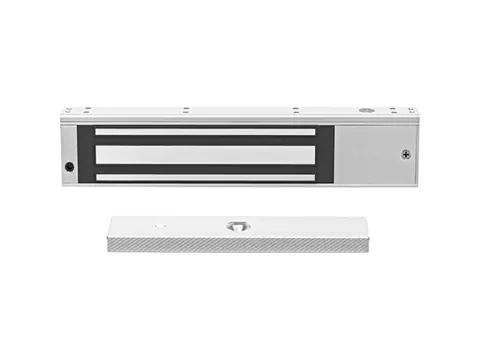
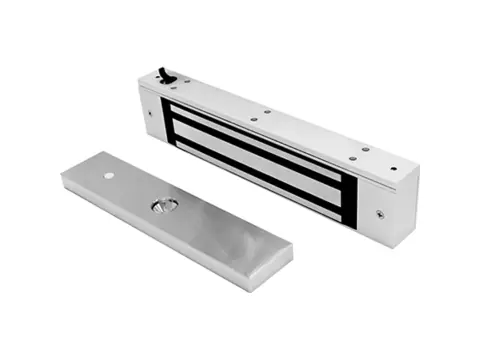
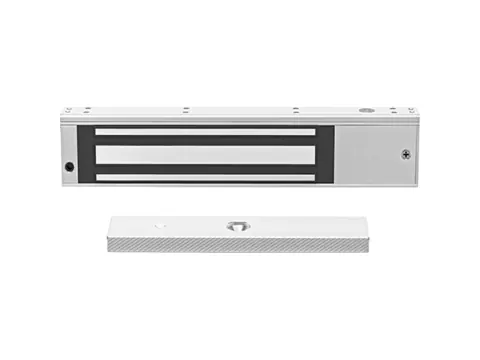
A surface-mount magnetic lock resists force in direct pull. The lock body sits on the frame header, the armature plate sits on the door, and opening the door has to pull the plate straight off the magnet face. That only works when the lock body is on the push side of the door: the side the door swings away from.
On most outward-opening doors the push side is also the secure side, so the lock screws straight to the underside of the header and the armature bolts to the door face. Brackets exist for every case where that simple arrangement does not fit. Start with the door:
| Door situation | Lock body mounts on | Armature mounts on | What to order |
|---|---|---|---|
| Outswing (opens away from the secure side), header underside deep enough for the lock body | Underside of the header, secure side | Door face | Lock only, no bracket |
| Outswing, header too narrow, recessed or uneven | L bracket fixed to the frame | Door face | L bracket |
| Inswing (opens toward the secure side), lock on the secure side | L plate on the head of the frame, above the door’s swing | Z plate on the door | ZL bracket set |
| Frameless glass leaf below a framed header or transom | Header (plus an L bracket if it is narrow) | U bracket clamped over the top edge of the glass | U bracket |
| Frameless glass with no header or fixed frame above | A separate glass mount for the lock body | U bracket | Send photos before ordering |
| Double-acting door (swings both ways) | Not suited to a standard maglock | Not applicable | Electric drop bolt instead |
| Pair of doors | As above, for each leaf | As above, for each leaf | Double lock plus brackets per leaf |
The push side is where you stand to push the door open; the pull side is the side it swings toward. Datasheets and installers do not always describe inswing and outswing from the same side of the door, so the safest order detail is a photo of the door head taken from the secure side.
Sliding doors are a separate case. The magnet face has to sit at right angles to the direction of travel, usually on the jamb, which needs a different mounting arrangement from the brackets below.
ZL bracket for inward-opening doors
On an inswing door the secure side is the pull side. If you fit the lock there in the standard position, the magnet faces the wrong way: opening the door would push the armature into the lock instead of pulling it away, and the lock body sits in the door’s path. Mounting the lock on the unsecured side instead leaves the body, its fixings and the cable exposed to tampering and weather.
A ZL bracket set turns the geometry around. It has two parts:
- L plate (lock side). Fixes the lock body to the head of the frame on the secure side, above the door’s swing, with the magnet face pointing into the room.
- Z plate (door side). Screws to the secure face of the door near the top, then steps out and up so the armature hangs in front of the magnet face.
When the door opens into the room, the Z plate moves away from the lock and pulls the armature straight off the magnet: the same direct-pull loading as a standard installation. On the ZL sets we supply for 280 kg (600 lb) locks, the lock-side plate runs the 250 mm length of the lock body and the door-side plate matches the 180 mm armature.
Before specifying a ZL set, check four things:
- There is enough solid frame or wall above the opening to fix the L plate.
- The Z plate clears the header and frame stop through the full swing.
- The door closer and the ZL set do not compete for the same space. On an inswing door the closer often sits on the same side of the door head.
- On hollow metal doors, the Z plate is fixed with through-bolts or rivet nuts, not self-tapping screws into thin sheet.
L bracket for narrow frames
The lock body needs a flat, solid mounting surface along its whole length. Slim aluminum shopfront sections, frames with a deep stop, recessed heads and trimmed timber frames often don’t offer one. An L bracket fixes one leg to the frame and forms a flat ledge for the lock body with the other, holding the magnet face in line with the armature on the door.
Use an L bracket when the door opens away from the lock side as normal but the header underside is too narrow, recessed or uneven. If the door opens toward the lock side, you need the ZL set instead. An L bracket on its own moves the lock body; it does not change the direction of pull.
Three details decide whether an L bracket holds:
- Fix the frame leg into solid material, or use rivet nuts in hollow aluminum sections. Thin trim and glazing beads are not structural.
- Check that the top of the door clears the bracket leg through its full swing.
- Keep the lock body parallel to the door face. A ledge that flexes lets the armature peel off at an angle, and a maglock holds far less in peel than in straight pull.
U bracket for frameless glass
A frameless glass door has no stile to screw an armature into, and toughened (tempered) glass cannot be drilled after it has been tempered. A U bracket is an aluminum channel that fits over the top edge of the glass leaf, clamps with set screws over protective pads, and carries the armature on its face. The lock body stays on the framed header or transom above.
Frameless doors are commonly 10 mm or 12 mm glass, but U brackets are made for a clamp range rather than one size. The U bracket we supply for 280 kg (600 lb) locks takes glass from 8 to 15 mm. Measure the actual leaf, not the drawing.
Before you order a U bracket, confirm:
- A framed header or transom exists. The U bracket carries only the armature. If the door sits under fixed glass or open space, the lock body needs its own glass mount, so send photos first.
- The door is single-acting. Many frameless doors hang on floor springs or pivots that let the leaf swing both ways, and a surface maglock only suits a leaf that swings one way. For double-acting glass doors, use an electric drop bolt with a glass-door bracket.
- The gap works. Measure from the top of the glass to the header. The armature must land flat on the magnet face when the door closes. If the header is too narrow for the lock body, add an L bracket.
- The clamp is fitted gently. Keep the pads between clamp and glass, and tighten the set screws evenly. Point loads can crack tempered glass.
Double doors and paired brackets
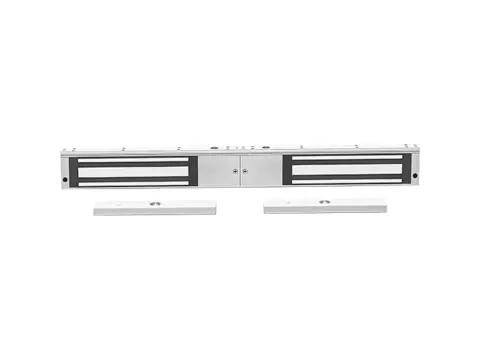
Pairs follow the same rules for each leaf. The usual lock is a double maglock: one long body with two independent magnets, mounted centered on the header across the meeting stiles, with a separate armature for each leaf. Brackets are then chosen per leaf:
- Inswing pair: a ZL arrangement on each leaf. Check that the lock-side plate is made for the double body’s length.
- Frameless glass pair: one U bracket per leaf, with the double lock body on the header.
- Narrow header: an L bracket sized for the double body, or two single locks each on its own L bracket.
Read double-lock ratings carefully. A double maglock sold as 1,200 lb normally has two 600 lb (280 kg) magnets, so each leaf is held at 600 lb. Compare it with single locks on the per-leaf figure.
A few other points apply to pairs:
- With a fixed center mullion, you can fit two single locks, one each side, instead of a double body.
- Rebated pairs with an overlapping astragal close in sequence, so they need a door coordinator. Both armatures must still land flat.
- Two magnets draw twice the current of one. Include both in the power supply sizing.
Size compatibility with lock bodies
A bracket is sized to a lock body, not to a holding-force label. Two locks sold as 280 kg (600 lb) can differ in length and hole positions, and larger holding-force classes use larger bodies and armatures. The labels are also rounded: 280 kg is about 617 lb, and a single lock sold in the 1,200 lb class is about 544 kg. Choosing the holding force itself is covered in our magnetic lock buying guide; for brackets, check dimensions.
The brackets we supply for 280 kg (600 lb) locks follow 250 mm lock bodies with 180 × 38 mm armature plates, and double-door locks with two 180 × 38 mm armatures. Shorter compact or stainless-steel bodies need a hole-position check before ordering.
| Check | Unit | Why it matters | Applies to |
|---|---|---|---|
| Lock body length × width | mm | The bracket must support the whole body | L, ZL |
| Mounting hole spacing | mm | Holes must line up without redrilling the bracket | L, ZL |
| Armature plate size and center-bolt position | mm | The door-side plate must hold the armature so it covers the magnet face | ZL, U |
| Header underside depth | mm | Narrower than the lock’s mounting face means an L bracket | All |
| Gap between door top and header | mm | Door-side parts must pass under the frame as the door swings | ZL, U |
| Door thickness | mm | Sets the through-bolt length for the armature and any door-side plate | ZL, no-bracket and L installs |
| Glass thickness | mm | Must fall inside the U bracket’s clamp range (8–15 mm on our 280 kg U bracket) | U |
| Holding-force class | kg (lb) | Bracket size and strength are made for one lock class | All |
Installation tips and common mistakes
Install tips that apply to every bracket type:
- Mount at the leading edge. Fit the lock at the top corner farthest from the hinges, where the lock has the longest lever arm against the door.
- Let the armature float. Fit the rubber washers supplied and don’t overtighten the center bolt. The plate should rock slightly so it can seat flat, with the locating pins (where supplied) stopping it from twisting.
- Check contact. With the door closed, the armature should cover the magnet face and sit flat along its length. Recheck after a few days of use, once hinges and closer have settled.
- Fix into solid material. Use through-bolts or rivet nuts in hollow sections, and security screws wherever fixings can be reached.
- Protect the cable. Route it through the frame with a grommet, clear of bracket edges and the door’s swing.
- Check suppression instructions. Follow the exact lock / output manufacturer’s instructions; do not automatically add a diode or MOV. Some maglocks prohibit a parallel diode because it delays release. Our magnetic lock wiring diagrams explain this check.
Common mistakes in bracket orders:
- Ordering a ZL set for an outswing door, or an L bracket in the hope that it fixes an inswing door.
- Fitting a U bracket and maglock to a double-acting glass door.
- Mixing brackets and locks from different ranges without checking hole positions.
- Overtightening the armature bolt, which stops the plate self-aligning and cuts the effective holding force.
- Mounting the lock on the unsecured side of an inswing door to avoid buying a bracket.
- Comparing a double lock’s combined rating with a single lock’s rating.
Two code points sit alongside the bracket choice. A maglock on an escape route is a life-safety item: in the US, NFPA 101 and the IBC set conditions for electrically locked egress doors. These typically include release from the egress side by a sensor or door-mounted hardware, release on loss of power and release on fire alarm activation. Details vary with the code path and occupancy, so confirm them with the authority having jurisdiction (AHJ). Fire-rated door sets are tested as complete assemblies (for example to EN 1634-1 or UL 10C), and drilling or adding hardware can affect the rating, so get approval from the door-set manufacturer or AHJ first.
Bracket checklist before you order
- Door swing relative to the secure side: inswing or outswing, and single- or double-acting
- Door construction: timber, hollow metal, aluminum-framed or frameless glass (glass thickness in mm)
- Header underside depth and the height available above the door, in mm
- For glass doors: whether a framed header or transom exists above the leaf
- Single door or pair, with or without a center mullion or astragal
- Lock body dimensions, hole spacing and armature size if you are reusing an existing lock
- Holding-force class in kg and lb, per leaf for double doors
- Door closer position, so the closer arm and bracket don’t clash
- Fire rating and egress requirements for the opening
- Photos of the door head from both sides, with a tape measure in shot
Next steps
Send us photos of the door head from both sides, the swing direction and the lock you plan to use, or tell us the holding force you need. We will confirm the bracket and lock combination, check the hole positions and ship lock and bracket as a matched set. Request a quote or samples and we will reply within 24 hours.
Suppression source
Only the suppression guidance was reviewed for this update. Securitron SAM installation manual, section 6.3 illustrates manufacturer-specific requirements; use the exact equipment manuals.
Frequently asked questions
Which maglock bracket do I need for an outward-opening door?
Usually none. If the door opens away from the secure side and the underside of the header is deep enough, the lock mounts under the header and the armature on the door face. If the header is too narrow or recessed, add an L bracket.
What is a ZL bracket used for?
It lets you fit a maglock on the secure side of an inward-opening door. The L plate fixes the lock body to the head of the frame with its face toward the room, and the Z plate carries the armature in front of it, so opening the door pulls the armature straight off the magnet.
Can a magnetic lock be used on a frameless glass door?
Yes, on a single-acting leaf below a framed header or transom. A U bracket clamps over the top edge of the glass and carries the armature, while the lock body mounts on the header. Double-acting glass doors need an electric drop bolt instead.
Will a bracket made for a 280 kg (600 lb) maglock fit a larger lock?
Usually not. Brackets are sized to a lock body's length, width and hole spacing, and larger holding-force classes use larger bodies and armatures. Check the dimensions, not the kg or lb label.
Does a bracket reduce a maglock's holding force?
A rigid, correctly aligned bracket should not. Rated holding force assumes a straight pull on an armature that sits flat on the magnet face, so a bracket that flexes, or an armature bolted too tight to self-align, lets the plate peel off well below the rating.
What glass thickness does a maglock U bracket fit?
Each U bracket has a clamp range; the one we supply for 280 kg (600 lb) locks takes glass from 8 to 15 mm. Frameless doors are commonly 10 or 12 mm glass, but measure the actual door before ordering.
Want a second opinion on your spec?
Send us your controller, credential type and environment — we'll recommend compatible hardware and quote within 24 hours.