Key takeaways
- Maglocks and shear locks hold only while powered, so they are always fail-safe. Strikes, drop bolts and electrified mortise locks come in fail-safe or fail-secure versions.
- Electric strikes and electrified mortise locks keep a mechanical latch and free egress through the inside lever, which is why they are the usual choice for timber, hollow-metal and fire-rated doors.
- On frameless or double-acting glass doors, a drop bolt or shear lock usually fits better than a surface maglock.
- Dry relay NC/COM versus NO/COM depends on unlock logic. Powered outputs have different conventions; use only suppression approved for the exact lock.
- Egress rules often decide the lock before security does: NFPA 101 and the IBC in the US, EN 13637 and EN 1634-1 in Europe. Confirm with the authority having jurisdiction.
The main types of electric locks used in access control are the electromagnetic lock (maglock), the electric drop bolt, the electric strike, the electrified mortise lock and the electromagnetic shear lock. Maglocks and shear locks are always fail-safe and suit glass, aluminum and retrofit doors; strikes and mortise locks keep a mechanical latch with free egress and suit timber, hollow-metal and fire-rated doors; drop bolts cover frameless and double-acting glass. Choose by door construction first, then egress requirements, then what must happen when power fails.
Electric lock types at a glance
| Lock type | Mounts on | Power-loss state | Egress from inside | Best fit | Watch out for |
|---|---|---|---|---|---|
| Electromagnetic lock (maglock) | Magnet on frame header, armature plate on door | Fail-safe only | Power must be cut by the approved egress-release arrangement | Glass, aluminum storefront and retrofit doors | Visible hardware; strict code conditions on egress doors |
| Electric drop bolt | Frame header; bolt drops into a strike on the door top | Fail-safe or fail-secure (per model) | Approved electrical release, or mechanical free egress; an inside key override is insufficient | Frameless and double-acting glass doors | Alignment; start-up current surge |
| Electric strike | Door jamb, replacing the strike plate | Fail-secure or fail-safe (often field-selectable) | Free, through the lockset’s inside lever | Timber and hollow-metal doors with a lockset | Frame cutting; latch preload |
| Electrified mortise lock | Inside the door, in the lock case | Fail-safe or fail-secure (often field-selectable) | Free, through the inside lever | High-traffic and fire-rated doors | Door prep; power transfer hinge |
| Electromagnetic shear lock | Concealed in header; armature mortised into door top | Fail-safe only | Power must be cut by the approved egress-release arrangement | Double-acting doors, concealed installs | Door must come to rest precisely aligned |
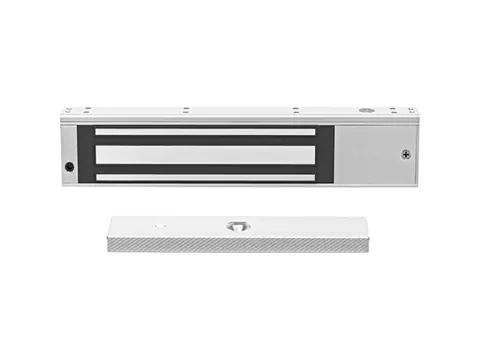
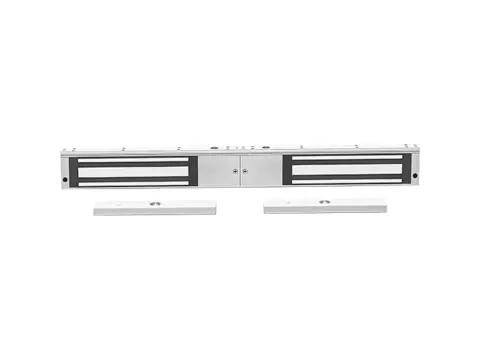
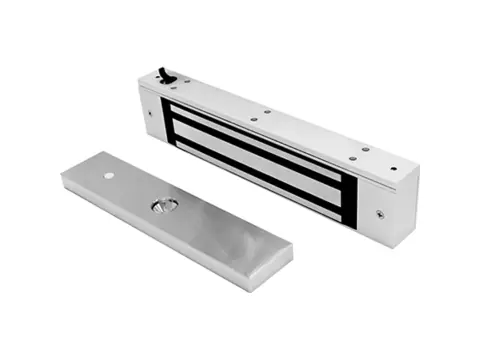
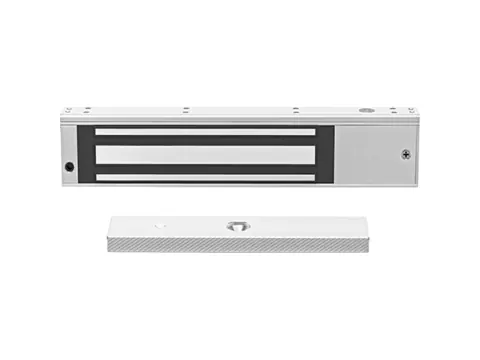
Maglock. An electromagnet on the header pulls a steel armature plate on the door. It provides no mechanical latch and holds only while current flows. Single-door units are commonly rated around 280 kg (600 lb) of holding force, with larger models for heavy or exposed doors. Many run on 12 or 24 V DC selected by jumper, and some add a lock-status output. See our range of magnetic locks and brackets.
Electric drop bolt. A solenoid or motor drives a bolt from the header down into a strike plate on top of the door. Many units sense door position through a magnet in the strike plate and throw the bolt only once the door has closed, after an adjustable relock delay. Browse electric bolt locks.
Electric strike. It replaces the strike plate in the jamb. The door’s existing lockset still latches; the strike controls a pivoting keeper that either holds the latch or lets it swing past.
Electrified mortise lock. The electric function sits inside the lock case: applying or removing power connects the outside lever to the latch. On a model designed for mechanical free egress, the inside lever retracts the latch independently of the electric entry-control function. Verify the lock function and required exit hardware.
Shear lock. This is an electromagnetic lock mortised into the header, with its armature set into the top edge of the door. When energized, the armature is pulled up and interlocks with the magnet body, so the lock resists the door’s sideways (shear) movement rather than a direct pull.
Maglock vs electric strike
This is the most common decision on a standard single-leaf door. The two locks differ in how they hold, how people get out and what happens in an outage.
| Factor | Maglock | Electric strike |
|---|---|---|
| How it holds | Magnetic attraction between magnet and armature | The door’s own latch, held by the strike keeper |
| Power-loss state | Always unlocked (fail-safe) | Locked (fail-secure) or unlocked (fail-safe), per model or setting |
| Egress | Approved electrical release, such as sensor-release or door-hardware-release arrangement | Suitable inside lever / exit device retracts the latch mechanically |
| Installation | Surface mount on the header; no frame cutting | Jamb cut-out; must match the lockset latch and door gap |
| Fire-rated doors | Does not provide positive latching; confirm permitted assembly and release arrangement | Use the exact fire-listed strike / door combination and permitted fail mode |
| Current draw | Continuous while locked | Fail-secure: only while unlocked. Fail-safe: continuous |
| Main limitation | Releases on power loss unless battery-backed | Security depends on latch, lockset and frame; preload can block release |
The maglock’s catch is egress. Because it has no latch, the only way out is to remove its power, so building codes set conditions. In the US, NFPA 101 and the IBC allow electrically locked egress doors only under specific arrangements. One example is sensor release: a sensor on the egress side unlocks the door as someone approaches, a manual release device near the door cuts lock power directly (independent of the access control electronics) and keeps the door unlocked for at least 30 seconds, and the lock also releases on fire-alarm or sprinkler activation and on loss of power. Another is door hardware release, where a switch inside the lever or exit device cuts lock power as the occupant operates it. Pair the lock with exit buttons and REX sensors that match the arrangement your authority having jurisdiction (AHJ) accepts, and confirm which code edition applies.
In Europe, electrically controlled exit systems on escape routes fall under EN 13637. Fire doors are tested as complete assemblies under EN 1634-1, so any lock you add must be covered by that door’s fire test evidence or certification.
An electric strike sidesteps most of this. With a suitable free-egress lockset, the inside lever retracts the latch independently of the strike, so egress is mechanical. That is why strikes and electrified mortise locks dominate on offices, corridors and fire doors, while maglocks dominate on glass and aluminum storefronts where cutting a jamb is impractical. One strike-specific trap: if door seals, a closer, wind or air pressure push the latch hard against the keeper, a standard strike may not release. Specify a strike rated for preload on those openings.
Drop bolt vs maglock on glass doors
Glass doors rarely carry a lockset, so the choice usually comes down to a maglock or a drop bolt. Both are available fail-safe; the difference is mechanical.
A maglock on glass mounts on the header, with the armature fixed to the glass by a clamp bracket on frameless doors. The armature must self-align and sit flat; follow the release circuitry and mounting instructions to avoid residual holding or delayed release. It does need the door to close flat against the magnet face, so it suits single-swing doors with a closer. Our maglock bracket guide explains which bracket fits which swing direction.
A drop bolt engages a strike on the top of the door, so it does not care which way the door swings. That makes it the usual choice for double-acting glass doors on floor springs, which have no stop for a magnet to seat against. The trade-off is precision: the bolt must land in the strike hole, so the door has to come to rest centered and still. Door-position sensing and relock delay help, but a well-adjusted floor spring or closer matters as much as the lock.
Other differences to weigh:
- Appearance: drop bolts are usually mortised into or mounted flush with the header; maglocks are surface-mounted and visible.
- Alignment tolerance: maglocks forgive sagging doors better; drop bolts jam or fail to throw when the door is off-center or under side load.
- Power pattern: maglocks draw steady current while locked; drop bolts draw a surge each time the bolt moves, then a lower holding current.
- Holding failure: a maglock loses force when the armature cannot sit flush (dirt, damaged plate, door sag); a drop bolt fails when the bolt misses the strike.
- Glass fixing: both need clamps sized to the glass thickness. Tempered (toughened) glass cannot be drilled after tempering, so the clamp carries the hardware.
Fail-safe and fail-secure by lock type
A fail-safe lock unlocks when power is removed; a fail-secure lock stays locked. The terms describe the secure (outside) side of the door. With strikes and mortise locks, the inside lever gives free egress either way. Our fail-safe vs fail-secure guide covers door-by-door choices in more depth.
- Maglock and shear lock: fail-safe only. An electromagnet cannot hold without current. If the door must stay secure during an outage, battery-back the supply or choose a different lock.
- Electric drop bolt: sold as fail-safe or fail-secure models. A fail-secure bolt must not obstruct required egress during power loss. An inside key override is not mechanical free egress: select approved hardware that opens from inside without a key, tool or special knowledge, or use a different permitted arrangement. An outside key override serves entry.
- Electric strike: both; many are field-reversible. Check the exact fire listing and permitted mode; many strike fire ratings apply only to fail-secure operation.
- Electrified mortise lock: both, often field-selectable. Fire-rated stair doors that must allow re-entry on alarm typically use a fail-safe electrified lockset: the outside lever is freed while the latch stays engaged, so the fire door remains latched. A fail-safe strike would leave it unlatched.
A power-interruption release unlocks power-to-lock hardware only. Other alarm functions can command powered unlocking where the design requires it; do not assume cutting power will unlock a fail-secure lock. Required free egress must work through the selected mechanical or approved electrical arrangement.
Power and wiring differences
| Lock | When it draws current | Controller relay contacts | Suppression |
|---|---|---|---|
| Maglock | Continuously while locked | NC + COM in the dry-relay example below | Exact manual; an added diode can be prohibited |
| Drop bolt, fail-safe | Surge on each throw, then holding current while locked | NC + COM, or the lock’s own control input | Per datasheet; many include it |
| Drop bolt, fail-secure | Surge on retraction, then holding current while unlocked | NO + COM, or the lock’s own control input | Per datasheet |
| Electric strike, fail-secure | Only while unlocked | NO + COM in the dry-relay example | Manufacturer-specified suppression / accessory |
| Electric strike, fail-safe | Continuously while locked | NC + COM in the dry-relay example | Manufacturer-specified suppression / accessory |
| Electrified mortise lock | Depends on mode; motor-driven types draw briefly | NC or NO, matching the mode | Per datasheet; wired through a power transfer hinge |
Relay contacts. These examples assume dry contacts with the relay de-energized while locked and energized to unlock. NC and COM are then connected while locked, so a fail-safe lock stays powered. Granting access energizes the relay, opens NC and releases the lock. A fail-secure lock on NO and COM gets power only while the relay operates. Reversed logic changes this; powered outputs need the manufacturer’s diagram. On Altronix ACM powered outputs, COM is negative, not the dry-contact supply-positive common.
Suppression. Use the exact lock / output instructions. Securitron M32/M62/M82B locks prohibit a parallel reverse diode because it interferes with quick release; HES offers specified surge-protection accessories for its strikes. Do not substitute a generic diode or arbitrary MOV for the approved arrangement.
Voltage and cabling. Most access control locks run on 12 or 24 V DC, and many maglocks are dual-voltage by jumper. Many dual-voltage locks draw less current at 24 V, reducing cable drop; the exact ratio depends on the model. Locks inside the door leaf (mortise locks, electrified exit devices) need a power transfer hinge or door loop to get cable across the hinge side.
Power supply. Separately protected lock and electronics outputs can improve fault isolation. Where alarm release is required, configure the approved interface to interrupt battery-backed power-to-lock outputs. Size for actual operating, simultaneous peak and standby conditions, and follow fuse / PTC ratings. The magnetic lock wiring diagrams show the connections, and our guide to sizing an access control power supply covers current budgets, drop bolt surges and battery backup.
Which lock for which door
| Door | Usual first choice | Why |
|---|---|---|
| Framed aluminum or glass storefront, out-swing | Maglock, 280 kg (600 lb) class, on the header | No frame cutting; specify the accepted independent egress-release arrangement |
| In-swing door without a lockset | Maglock with a ZL bracket | Bracket brings the armature to the magnet face |
| Frameless glass, single swing | Drop bolt with glass-door strike clamp, or maglock with glass clamp bracket | Neither needs holes in tempered glass |
| Frameless glass, double-acting on a floor spring | Fail-safe drop bolt or shear lock | Engages from above regardless of swing direction |
| Timber or hollow-metal office door with a lever set | Electric strike, usually fail-secure | Free egress through the lever; stays locked in an outage |
| Fire-rated corridor door | Fire-rated fail-secure strike or electrified mortise lock | Door stays positively latched; confirm against the door’s label or certificate |
| Stair door that must unlock for re-entry on alarm | Fail-safe electrified mortise lockset | Frees the outside lever while the latch stays engaged |
| Server room or stock room | Fail-secure strike or electrified mortise lock | Secure during outages; occupants exit by lever |
Before ordering, walk each opening with this checklist:
- Door material and construction: framed or frameless glass, aluminum, timber, hollow metal; glass thickness if applicable
- Swing: in-swing, out-swing or double-acting; single or double leaf
- Is it a required egress door, and which code and edition does the AHJ enforce?
- Is the door fire-rated, and what does its label or certificate allow?
- Required power-loss state for this door: fail-safe or fail-secure
- Existing lockset or exit device to keep or replace
- Cable path: header access, and a power transfer hinge for in-door locks
- Lock voltage (12 or 24 V DC), available supply capacity and battery backup
- Monitoring: door status sensor and lock or bolt status output
- Environment: indoor or outdoor, temperature range, exposure to water
- Brackets, glass clamps and a closer or floor spring that returns the door reliably
- Required product / system listings for the accepted arrangement, such as UL 294 or UL 1034 where applicable; these do not replace door-assembly approval
Next steps
Send us your door schedule with door type, swing, fail mode and lock voltage. We will match maglocks or drop bolts with the right brackets, exit buttons and power supplies, confirm compatibility with your controller, and ship samples for a trial door if you need them. Request a quote and we will reply within 24 hours.
Sources
- HES: fail-safe versus fail-secure and mechanical egress; 1500 series fire listing.
- ICC: electrical egress-locking arrangements; UL: locking configurations and free-egress principles.
- Securitron M32/M62/M82B installation manual: quick release and suppression; HES SMART Pac III.
- Altronix ACM manual: powered and dry output terminals.
- BSI: EN 13637 scope; EN 1634 series.
Frequently asked questions
What are the main types of electric locks for access control?
The five common types are the electromagnetic lock (maglock), electric drop bolt, electric strike, electrified mortise lock and electromagnetic shear lock. They differ in where they mount, how occupants get out and what happens when power is lost.
Can a magnetic lock be fail-secure?
No. An electromagnet holds only while current flows, so a maglock always releases on power loss. If a door must stay locked during an outage, use a battery-backed supply or choose a fail-secure strike, drop bolt or mortise lock with mechanical egress.
Which is better, a mag lock or an electric strike?
Neither in every case. A strike keeps a mechanical latch and free egress through the lever, which suits timber, hollow-metal and fire-rated doors; a maglock avoids frame cutting and suits glass and aluminum doors, but needs a code-compliant release arrangement on egress doors.
What is the best electric lock for a frameless glass door?
For a single-swing frameless glass door, a maglock with a glass clamp bracket or a drop bolt with a glass-door strike clamp both work. For double-acting doors on floor springs, a drop bolt or shear lock is usually the practical option.
Can I fit an electric strike to a fire door?
Use a strike permitted for that fire-rated door assembly and its listed fail mode; many fire listings apply only to fail-secure operation. Preserve positive latching and check the assembly evidence before cutting the frame.
Do electric locks need a diode?
Use the suppression specified by the exact manufacturer. Some DC locks require a diode or MOV; others have internal circuitry and prohibit an added parallel diode because it slows release. A plain diode must not be fitted across an AC supply.
Want a second opinion on your spec?
Send us your controller, credential type and environment — we'll recommend compatible hardware and quote within 24 hours.