Turnstile & Speed-Gate Readers: QR, RFID and Face
Turnstile card readers, QR scanners and face terminals for tripod, swing and speed gates, with Wiegand, RS485, RS232 or TTL output to the gate board.
Send us your controller model, card type and install environment. We'll shortlist compatible hardware and quote within 24 hours.
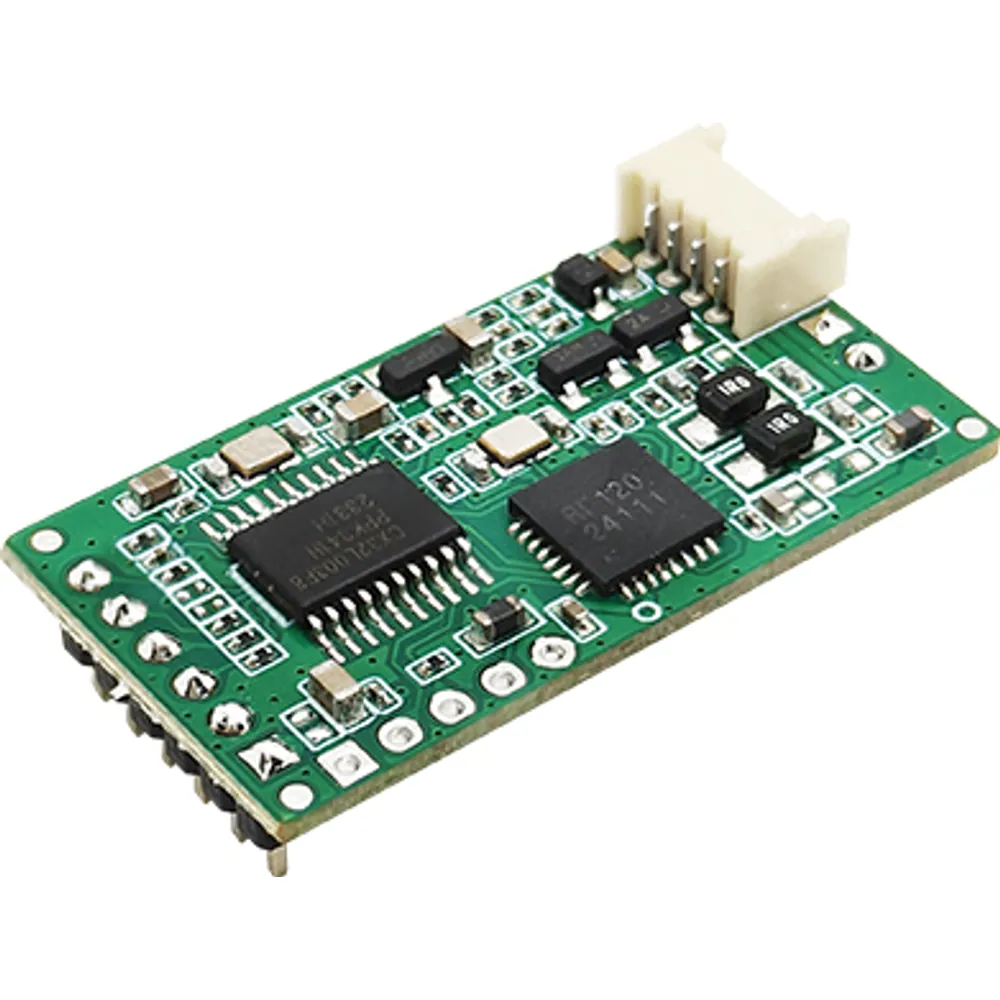
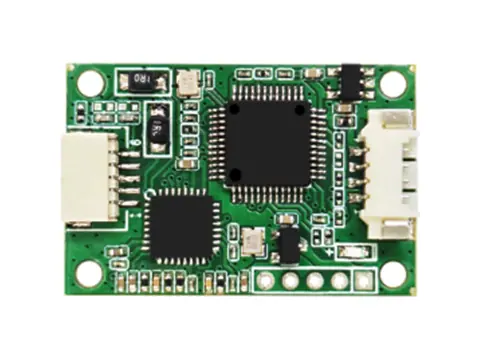
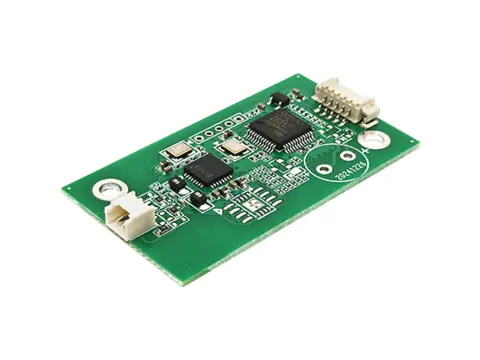
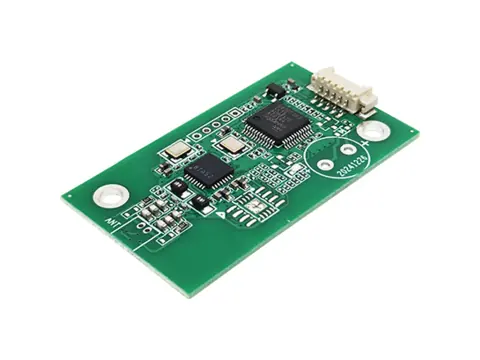
30 × 16 × 8.9 mm module reading EM4100-family 125 kHz cards and ISO14443A/B MIFARE, DESFire and NTAG credentials through one 3.3 V UART, with external LF and HF antennas.
The HF-250 is a dual-frequency RFID module that reads 125 kHz EM cards and 13.56 MHz MIFARE and NFC credentials through a single 3.3 V TTL UART. At 30 × 16 × 8.9 mm and about 2.0 g as a bare board, it fits OEM products whose users carry a mix of older proximity cards and newer smart cards: EV chargers, service terminals, kiosks, keyboards and fare-collection equipment.
On the high-frequency side it supports ISO/IEC 14443A, ISO/IEC 14443B and ISO/IEC 18092, covering MIFARE Classic, MIFARE DESFire EV1/EV2, MIFARE Ultralight and Ultralight C, NTAG2xx, contactless CPU (microprocessor) cards and NFC Forum Type 1, 2 and 4 tags. On the low-frequency side it reads EM4100, EM4102, EM4200, EM4305 and EM4450. Both antennas are external: a 50 Ω coil for 13.56 MHz and a 490 µH ±10 µH coil for 125 kHz, so each can be shaped to your housing.
In active mode the module looks for cards and reports them on its own; in passive mode it reads only when the host sends a command. The baud rate is adjustable from 9600 to 115200 bps (default 115200). A configuration utility handles parameter changes, and firmware can be upgraded over the serial port.
The 6-pin, 2.0 mm pitch header carries +5 V DC, GND, TXD and RXD; pins 5 and 6 (SCL/D1, SDA/D0) have no function on this version. UART signals are 3.3 V TTL. Antenna connections are made on the 4-pin, 1.25 mm connector (ask for the per-pin assignment with your sample), and a 2-pin, 2.0 mm header is unused. Current draw is up to 120 mA reading and 100 mA standby. No certification is listed for the bare module. The HF-240 (13.56 MHz) and LF-150 (125 kHz) share the same outline and 6-pin header.
| Frequencies | 125 kHz and 13.56 MHz |
|---|---|
| HF standards | ISO/IEC 14443A, ISO/IEC 14443B, ISO/IEC 18092 |
| HF cards and tags | MIFARE Classic, MIFARE DESFire EV1/EV2, MIFARE Ultralight, MIFARE Ultralight C, NTAG2xx, contactless CPU (microprocessor) cards, NFC Forum Type 1, 2 and 4 tags |
| LF cards and tags | EM4100, EM4102, EM4200, EM4305, EM4450 |
| HF antenna | External, 50 Ω (at 13.56 MHz) |
| LF antenna | External, 490 µH ±10 µH (at 125 kHz) |
| Reading modes | Active (automatic) or passive (on host read command) |
| Host interface | UART, TTL 3.3 V levels |
|---|---|
| Baud rate | 9600–115200 bps (default 115200) |
| Configuration | Parameters and firmware updated with the configuration utility |
| Firmware update | Via serial port |
| Connectors | 6-pin 2.0 mm pitch (power/UART); 4-pin 1.25 mm (antennas); 2-pin 2.0 mm (not used) |
| Supply voltage | 5 V DC |
|---|---|
| Operating current | ≤ 120 mA |
| Standby current | ≤ 100 mA |
| Dimensions | 30 × 16 × 8.9 mm ±1.0 mm |
|---|---|
| Weight | Approx. 2.0 g (bare board) |
| Operating temperature | –20 to +60 °C (–4 to +140 °F) |
| Operating humidity | 20–80% RH, non-condensing |
| Storage temperature | –40 to +80 °C (–40 to +176 °F) |
| Certification | None listed for the module |
| Band | Standards | Credentials | Antenna |
|---|---|---|---|
| 125 kHz (LF) | EM4xxx family | EM4100, EM4102, EM4200, EM4305, EM4450 | External, 490 µH ±10 µH |
| 13.56 MHz (HF) | ISO/IEC 14443A/B, ISO/IEC 18092 | MIFARE Classic, DESFire EV1/EV2, Ultralight, Ultralight C, NTAG2xx, CPU cards, NFC Forum Type 1/2/4 | External, 50 Ω |
Both bands are read by the same module and reported over the same UART.
| Pin | Signal | Function |
|---|---|---|
| P1-1 | 5V | Power supply, +5 V DC |
| P1-2 | GND | Ground |
| P1-3 | TXD | UART transmit (3.3 V TTL) |
| P1-4 | RXD | UART receive (3.3 V TTL) |
| P1-5 | SCL/D1 | No function |
| P1-6 | SDA/D0 | No function |
| P2 | ANT | External LF and HF antenna connections |
| P3-1 | NC | No function |
| P3-2 | NC | No function |
P1: 6-pin, 2.0 mm pitch. P2: 4-pin, 1.25 mm pitch antenna connector. P3: 2-pin, 2.0 mm pitch.
Specifications can change between production batches. Confirm the current revision with us before placing volume orders.
Quote the SKU that matches your frequency, interface and mounting. Not sure? Send us your controller model and we will pick the variant for you.
| SKU | Configuration | Actions |
|---|---|---|
| HF-250-D-T | Dual-frequency 125 kHz + 13.56 MHz module, 30 × 16 mm, UART (3.3 V TTL) interface, external LF and HF antenna connector |
Turnstile card readers, QR scanners and face terminals for tripod, swing and speed gates, with Wiegand, RS485, RS232 or TTL output to the gate board.
Gym access control system hardware for 24/7 clubs: fob and wristband readers, face and QR terminals, anti-passback controllers and no-touch exit buttons.
EV charger RFID cards, key fobs and 13.56 MHz reader modules for charger OEMs and operators: UID formats, OCPP idTag mapping and UART integration notes.
EM4100, EM4102, EM4200, EM4305 and EM4450 credentials. HID Prox-format cards are not listed for this module.
MIFARE Classic, MIFARE DESFire EV1/EV2, MIFARE Ultralight and Ultralight C, NTAG2xx, contactless CPU cards and NFC Forum Type 1, 2 and 4 tags under ISO/IEC 14443A/B and 18092. ISO 15693 tags are not supported.
Two external coils: a 13.56 MHz antenna matched to 50 Ω and a 125 kHz coil of 490 µH ±10 µH. Both connect through the 4-pin, 1.25 mm antenna connector.
No read distance is specified, because it depends on the antennas you design in and on the card. Request a sample to measure range in your own housing.
Mechanically, yes: all three share the 30 × 16 mm outline and the same 6-pin power/UART header. Check the command set in your host firmware before switching.
Compare Wiegand, OSDP and RS485 reader interfaces: wiring, cable limits, AES-128 Secure Channel and steps for a compatible access-control migration.
125 kHz cards are cheap but easy to clone; 13.56 MHz cards add memory and, on DESFire-class chips, AES security. Compare range, chips, security and migration.
Wiegand 26-bit is an even parity bit, 8-bit facility code, 16-bit card number and odd parity bit. Convert card numbers to hex and back with the calculator.
Board-level 13.56 MHz reader/writer with on-board antenna and SAM interface pins, offered in ISO14443A, APDU, A/B and ISO15693 builds with TTL or Wiegand output.
Tiny USB CCID smart-card reader module that adds PC/SC-accessible 13.56 MHz card reading to tablets, PCs, kiosks and ticketing terminals via an external antenna.
USB-powered 47 × 26 mm multi-protocol HF module with built-in or external antenna, optional FeliCa, and SDKs for Windows, Android and Linux.
47 × 26 mm HF module reading ISO14443A/B, ISO15693 and NFC tags, with Wiegand or 3.3 V UART output, on-board or external antenna, and an optional FeliCa version.
Small-footprint 13.56 MHz read/write module that drives your own antenna through a 1.25 mm connector, with TTL, I2C or Wiegand output and Type A, APDU and A/B builds.
38 × 29 mm ISO14443A module that reads card UIDs and reads/writes MIFARE Classic sectors, available with TTL, Wiegand 34 or RS232 output.
30 × 16 mm embedded module pairing Bluetooth LE 5.1 with 125 kHz and 13.56 MHz card reading, for terminals that must accept cards, tags and phones.
47 × 26 mm module with on-board antenna that reads 125 kHz EM cards, or EM plus 13.56 MHz MIFARE/DESFire/NTAG, over USB or a UART/Wiegand connection.
Send your card type, interface and quantity. You get a quote, lead time and compatibility notes within 24 hours — samples available for most items.